
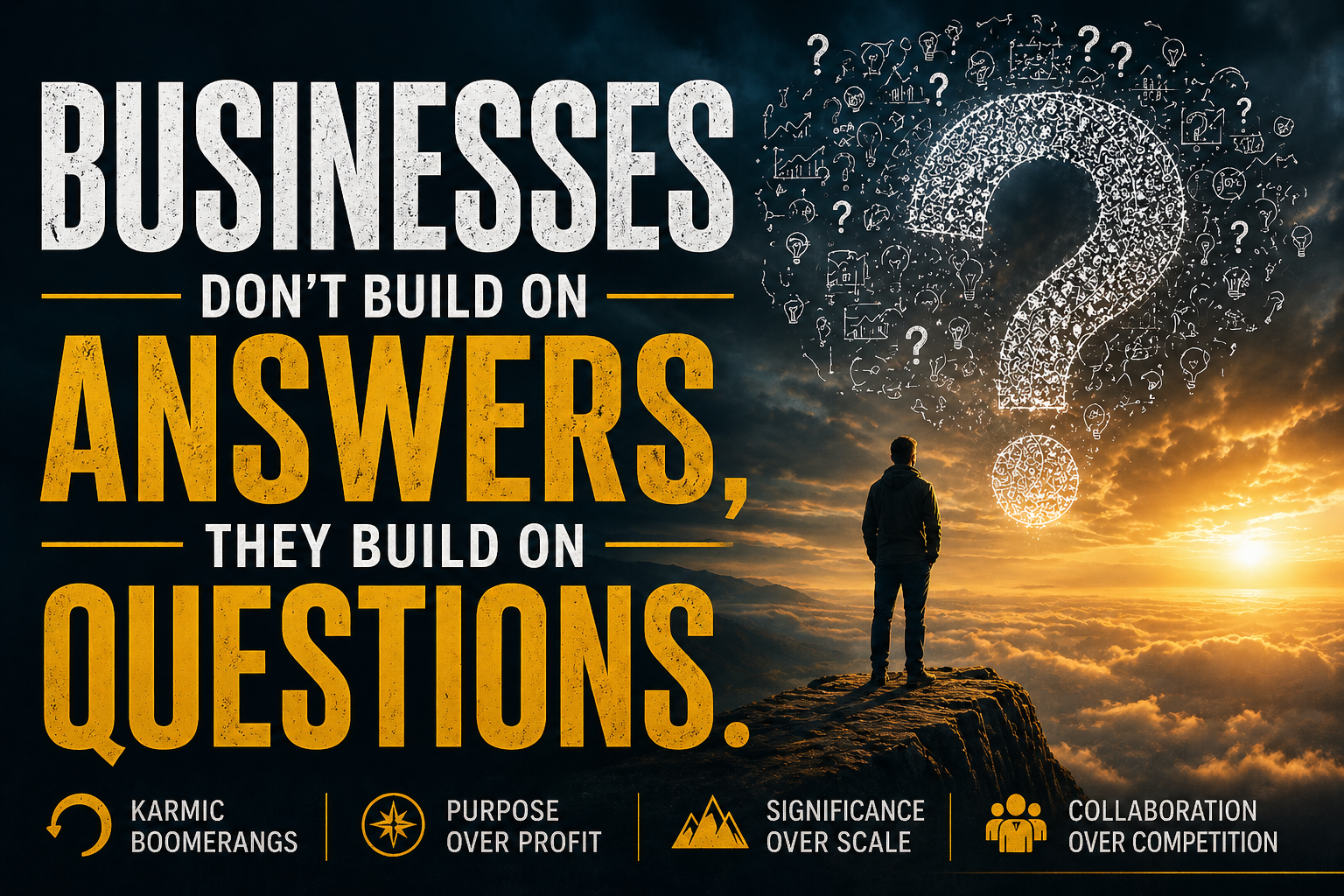
There is a quiet trap that I see founders fall into over and over again. It doesn’t look like a mistake. In fact, it often masquerades as confidence, experience, or even leadership. It’s the rush to answers. We reward it. We expect it. We celebrate the person in the room who can quickly say, “Here’s what we should do.” And in doing so, we unintentionally build cultures that prioritize speed over thinking. But here’s the truth. Answers are assumptions. Every time we rush to an answer, we are placing a bet. Not on what is true, but on what we think is true. And in a dynamic, messy, constantly shifting business environment, that’s a dangerous wager. The best businesses understand something fundamentally different. They don’t define themselves by the quality of their answers. They define themselves by the quality of their questions.
Most businesses operate as if success is about knowing. Knowing the right strategy. Knowing the right channel. Knowing the right hire. But the reality is, the most important decisions are rarely about what we know. They are about what we don’t know or can’t yet see. And that’s where questions come in. Questions create space. They slow things down just enough to separate reaction from intention. They force us to examine the assumptions we’ve been carrying forward, often unconsciously. They reveal blind spots that no amount of experience alone can uncover. Questions are not a strategy exercise you do once a year off-site. They are the operating system of how your business thinks, decides, and moves every single day.
When a business defaults to answers, a few things begin to happen. You move fast, but often in the wrong direction. You reinforce thinking that may no longer be relevant. You miss opportunities that were never surfaced. And over time, your team stops thinking altogether. Because if the expectation is that leadership has the answers, then the job of everyone else becomes execution, not curiosity. That’s when things get dangerous. You don’t just lose better decisions. You lose ownership. You lose engagement. You lose the organization’s collective intelligence. And perhaps most importantly, you lose adaptability.
The shift from answers to questions is subtle but profound. Answers close thinking. Questions expand it. Answers end conversations. Questions open entirely new ones. Answers reward confidence. Questions reward curiosity. And in a world where the landscape is constantly changing, curiosity will always outperform certainty. The best leaders I’ve worked with don’t walk into rooms with answers. They walk in with better questions.
There is a simple but powerful chain reaction that happens inside high-performing businesses. Better questions lead to better inputs. Better inputs lead to better decisions. Better decisions lead to better outcomes. It sounds almost too simple, but most businesses skip the first step. They start with answers, gather data to support those answers, and then wonder why the outcomes fall short. The real leverage is upstream. Start with the right question, not the comfortable one.
This way of operating isn’t reserved for big strategic moments. It shows up in everyday life. In hiring, what problem are we actually trying to solve with this role? In pricing, what are we assuming about willingness to pay? In team alignment, does everyone understand the why? In prioritization, is this important or just interesting? Over time, these questions compound. They sharpen thinking. They align teams. They create clarity without the need for constant oversight. You don’t have to micromanage a team that knows how to think.
When questions become the norm, something interesting happens. The organization starts to change. People begin to take ownership of thinking, not just doing. Conversations become more intentional. Decisions improve at every level, not just at the top. And curiosity replaces compliance. You don’t need another initiative to make this happen. You need practice. Open meetings with a question. Challenge assumptions in real time. Close conversations with clarity. Do it consistently, and the culture follows.
This isn’t about asking more questions. It’s about asking better ones. Focused. Precise. Relevant to what matters most right now. One well-placed question can unlock more than a dozen rushed answers ever could.
So I’ll leave you with this. What are the three to five questions that, if answered, would most improve how you and your team make decisions every single day? Don’t rush to answer it. Sit with it. Because the discomfort of not having the answer immediately is exactly the point.
The quality of your business is directly tied to the quality of your questions. Not occasionally. But every single day.